
Blog
Choosing a Family Dog: What Parents Should Consider Before Buying a Puppy

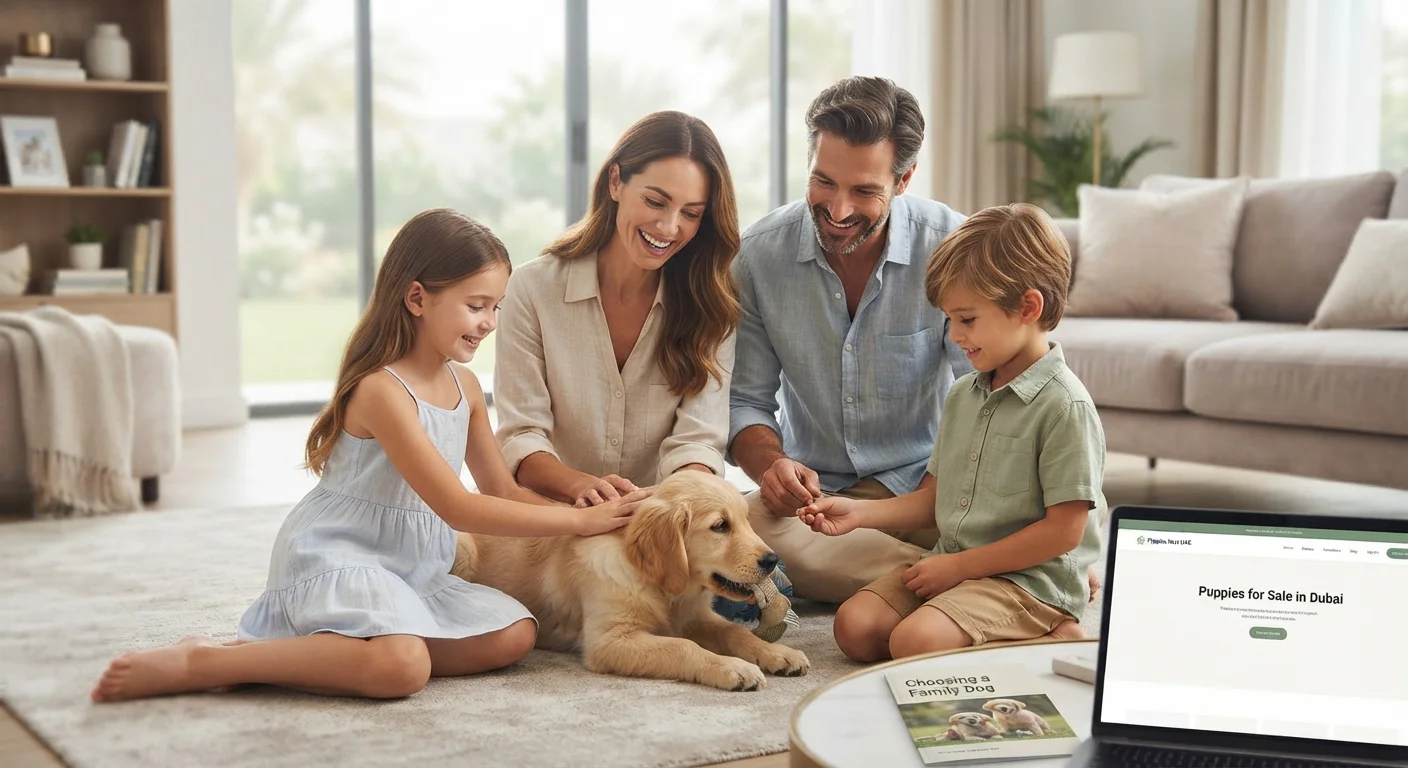
Bringing a dog into a family can be one of the most rewarding experiences for both parents and children. A well-matched dog can become a companion, encourage children to be active, teach them about responsibility, and create years of memorable experiences.
However, choosing a family dog requires more than selecting the puppy that looks the cutest. Parents need to think about temperament, adult size, exercise requirements, grooming, training, socialization, health, supervision, household routines, and the responsibilities that come with caring for an animal for many years.
This is particularly important for families researching dogs for sale in Dubai , where different breeds and sizes may be available and where the climate and urban lifestyle can influence daily dog care.
Parents may also encounter searches for puppies for sale in Abu Dhabi or advertisements for a teacup puppy for sale. While these searches can help families discover different options, location and size should not be the main factors determining which dog enters the household.
The best family dog is not necessarily the smallest, most popular, or most attractive puppy. It is the individual dog whose temperament, energy level, size, and care requirements are compatible with the family’s lifestyle.
This guide explains what parents should consider before buying a puppy and how the entire family can prepare for responsible dog ownership.
read more about corporate gift ideas
Start With the Family, Not the Puppy
Before visiting a puppy or browsing available dogs, parents should evaluate their own household.
Every family has a different schedule, home environment, financial situation, and level of experience with animals.
Ask basic questions first:
- How many hours is the home empty each day?
- How old are the children?
- Who will provide daily care?
- How much exercise can the family provide?
- Does anyone have experience training dogs?
- Is the home an apartment, townhouse, or villa?
- Are there other pets?
- How frequently does the family travel?
- Who will care for the dog during vacations?
- Can the family afford routine and unexpected veterinary care?
These questions may seem simple, but they can eliminate unsuitable choices before the family becomes emotionally attached to a particular puppy.
A puppy should fit the family’s real lifestyle rather than an imagined lifestyle.
For example, parents may hope that their children will walk the dog every morning, but young children cannot be expected to take complete responsibility for a dog. Adults must be prepared to provide the majority of the care.
A Family Dog Is an Adult Responsibility
Children can certainly participate in caring for a dog, but the ultimate responsibility belongs to the adults.
Parents are responsible for making sure the dog receives:
- Appropriate food
- Fresh water
- Veterinary care
- Vaccinations
- Parasite prevention
- Exercise
- Training
- Grooming
- Safe housing
- Supervision
- Socialization
- Emotional companionship
Children can help with age-appropriate tasks, but they should not be responsible for essential care.
A puppy may be exciting for the first few weeks, but interest can change as children return to school, develop new hobbies, or become busy with activities.
Parents should therefore choose a dog they are personally prepared to care for, even if children eventually become heavily involved.
Consider the Children’s Ages
The age of children in the household can influence which type of dog is appropriate.
Toddlers and very young children require constant supervision around dogs.
Older children may be capable of learning more about responsible interaction, training, grooming, and basic care.
Teenagers may be able to participate in walking and training more independently, although adults should still remain responsible for the dog’s welfare.
A family with a two-year-old child has very different requirements from a family with teenagers.
Parents should therefore consider the entire household rather than simply choosing a breed described as “family-friendly.”
Temperament Should Be a Top Priority
Temperament is one of the most important characteristics to evaluate before bringing a dog into a family.
A dog that is confident, adaptable, and comfortable with appropriate human interaction may be easier for a family to manage.
However, temperament varies between individual dogs.
Breed information can provide general expectations, but it cannot guarantee how a particular puppy will behave.
When meeting a puppy, observe its behavior.
Does it show curiosity?
Does it interact appropriately with people?
Does it seem comfortable in its environment?
Does it recover reasonably well after something unfamiliar happens?
Does it interact normally with littermates?
Does it tolerate gentle handling?
Parents should avoid choosing a puppy solely because it immediately runs toward them or appears particularly energetic.
The goal is to understand the puppy’s overall behavior and whether it seems compatible with the household.
What Does a Good Family Temperament Look Like?
There is no single personality that makes a perfect family dog.
However, parents may prefer a dog that is:
- Social but not excessively demanding
- Playful without being uncontrollably energetic
- Comfortable with appropriate handling
- Able to settle down after activity
- Responsive to people
- Adaptable to normal household activity
- Suitable for consistent training
Individual personality still matters.
A calm dog can become difficult without exercise and training, while an energetic dog can become an excellent family companion when its needs are properly met.
Size Does Not Determine Friendliness
Many parents assume that a small dog is automatically safer or easier for children.
This is not necessarily true.
A small dog can become frightened easily, and some small dogs may react strongly when they feel threatened.
A large dog may be calm and patient, while a tiny dog may be energetic and sensitive.
Size should therefore be evaluated separately from temperament.
Parents should ask:
- How large will the dog become?
- Can children safely interact with it?
- Can adults physically control the dog?
- Does the dog have enough space?
- Can the family manage its exercise requirements?
- Is the dog vulnerable to accidental injury from young children?
The right size depends on the entire household.
read more about birthday gifts for girls
Very Small Dogs Are Not Automatically Easier
Families searching for a teacup puppy for sale may be attracted to extremely small dogs because they appear easy to carry and convenient for apartment living.
However, very small dogs are not automatically easier family pets.
Their tiny bodies may make them more vulnerable to accidental injury, especially in homes with young children.
They may also have specific nutritional, health, handling, and temperature-management considerations.
A very small dog can still need:
- Daily exercise
- Training
- Socialization
- Grooming
- Veterinary care
- Mental stimulation
- Supervision
The family should evaluate the individual puppy rather than assuming that small size equals low responsibility.
Teach Children How to Handle Small Dogs
If a family chooses a very small dog, children need clear rules.
They should understand that a tiny puppy is not a toy.
Children should not:
- Pick up the puppy without permission
- Carry it while running
- Drop it
- Pull its legs or tail
- Squeeze it
- Chase it
- Disturb it while sleeping
- Take food away
- Force physical contact
Adults should supervise young children whenever they interact with a small dog.
This protects both the child and the puppy.
Consider Adult Size, Not Puppy Size
A puppy may be small enough to fit comfortably in a child’s arms today, but that does not mean it will remain that size.
Parents should research expected adult weight and height before choosing a breed.
This is especially important when searching for puppies advertised using size-related terms.
Ask for information about:
- Parents’ size
- Breed characteristics
- Expected adult weight
- Growth pattern
- Any available health information
The goal is to understand what the dog will be like several years from now, not simply what it looks like when the family first meets it.
Exercise Requirements Matter
Every dog needs appropriate exercise, but the amount varies.
A family should choose a dog whose energy level matches the amount of activity they can consistently provide.
Some dogs may need long walks and substantial physical activity.
Others may be satisfied with shorter walks combined with play and mental stimulation.
Parents should consider their schedule realistically.
Can someone provide exercise every day?
What happens during school days?
What happens when parents are working?
What happens during extremely hot weather?
The dog still needs appropriate activity even when the family is busy.
Exercise in the UAE Climate
Families considering dogs for sale in Dubai should pay special attention to the local climate.
The UAE’s hot weather can make outdoor exercise challenging during certain parts of the day.
Parents should plan walks and outdoor activities around safer temperatures.
During very hot periods, indoor play, training, enrichment activities, and other appropriate forms of stimulation can become particularly useful.
Fresh water should always be available.
Dogs should also have access to a comfortable indoor environment.
Families should never assume that because a dog enjoys being outside, it is safe to leave it outdoors for extended periods during extreme heat.
Outdoor Space Is Helpful but Not Essential
A garden can provide additional space, but it does not replace exercise or interaction.
Dogs need opportunities to explore beyond the same small area, depending on their individual needs.
They also need training and social experiences.
If a family has a garden, it should be secure.
Check:
- Gates
- Fences
- Pool access
- Plants
- Chemicals
- Electrical cables
- Small openings
- Storage areas
Puppies are excellent at discovering hazards that adults overlook.
Grooming Requirements
Grooming should be considered before choosing a dog.
Some breeds require regular brushing, while others need frequent professional grooming.
Parents should ask:
- How often does the coat need brushing?
- Does the dog shed heavily?
- Is professional grooming required?
- How difficult is coat maintenance?
- How often should nails be trimmed?
- Does the breed require regular ear care?
- What dental care will be needed?
A beautiful coat can require substantial time and money.
If the family does not have time for grooming, a high-maintenance breed may not be a good match.
Children Can Participate in Grooming
Grooming can become an excellent way for older children to learn responsibility.
Under adult supervision, children may help with simple activities such as gentle brushing.
However, they should not be expected to handle difficult grooming tasks independently.
Parents should teach children to stop when the dog becomes uncomfortable.
The experience should be calm and positive rather than forced.
Training Is Essential for Family Dogs
A family dog needs training.
Training makes everyday life easier and helps children and adults communicate with the dog.
Basic training may include:
- Name recognition
- Sit
- Stay
- Come
- Leave it
- Walking on a leash
- Appropriate chewing
- Toilet training
- Settling down
- Greeting people politely
Training should begin early and continue as the dog grows.
Parents should use consistent expectations.
If one family member allows a behavior while another tries to stop it, the dog may become confused.
Consistency Across the Household
A family should agree on basic rules before bringing home the puppy.
For example:
Can the dog sleep on the sofa?
Is it allowed in bedrooms?
Where should it eat?
Where should it sleep?
Where should it go to the toilet?
Who feeds it?
Who walks it?
What behaviors are not allowed?
Everyone should follow the same rules.
Consistency makes learning easier.
Toilet Training Is a Family Project
Puppy toilet training can be challenging, especially during the first few months.
Young puppies have limited bladder control and need frequent opportunities to eliminate appropriately.
Parents should establish a routine.
Take the puppy to its designated toilet area after:
- Waking
- Eating
- Drinking
- Playing
- Sleeping
- Excitement
Praise appropriate behavior immediately.
Accidents are normal.
Children should understand that accidents are not reasons to punish or frighten the puppy.
Adults should manage the training process patiently.
Supervision Is Non-Negotiable
One of the most important rules for families with children is that dogs and young children should not be left together without appropriate adult supervision.
Even a gentle dog can react unexpectedly if frightened, hurt, startled, or disturbed while eating or sleeping.
Likewise, children may unintentionally behave in ways the dog finds threatening.
Supervision protects both sides.
Parents should pay attention to body language and teach children to recognize when a dog wants space.
read more about romantic gifts
Teach Children Dog Body Language
Children can learn to recognize basic signs of discomfort.
A dog may need space if it:
- Moves away
- Hides
- Turns its head
- Avoids interaction
- Becomes tense
- Growls
- Shows other signs of distress
A growl should not be treated simply as “bad behavior.”
It can be a warning that the dog is uncomfortable.
Children should learn to stop the interaction and call an adult.
Never Disturb a Dog While Eating
Food can be a sensitive subject for some dogs.
Children should never take food or treats away from a dog.
They should not put their hands into the dog’s food bowl or attempt to play with it while it is eating.
Parents can use training to teach appropriate behavior around food, but children should still respect the dog’s space.
This is especially important when young children are involved.
Give the Dog a Private Space
Every family dog should have a place where it can rest without being disturbed.
This could be:
- A crate
- A bed
- A quiet room
- A designated corner
Children should understand that when the dog is resting in its own space, they should leave it alone.
A private area gives the dog a way to retreat when household activity becomes overwhelming.
Socialization Is Important for Family Dogs
Socialization helps puppies learn how to respond appropriately to the world around them.
A well-socialized puppy can gradually become comfortable with:
- Different people
- Household noises
- New environments
- Car travel
- Different surfaces
- Grooming
- Appropriate interactions with other dogs
Socialization should be gradual and positive.
The goal is not to overwhelm the puppy with constant new experiences.
Instead, introduce situations in a controlled way and allow the puppy time to adjust.
Socialization Does Not Mean Meeting Everyone
Some parents believe that a puppy should be introduced to as many people and animals as possible.
Quantity is not the main objective.
Quality matters.
A puppy that is repeatedly frightened by overwhelming experiences may become less confident.
Parents should focus on calm, positive interactions.
Other Pets in the Family
Families that already have pets need to consider how the new puppy will fit into the household.
Dogs, cats, and other animals have individual personalities.
A new puppy can be exciting for the owners but stressful for an existing pet.
Introductions should be gradual and supervised.
Each animal should have access to its own food, water, resting areas, and private space.
Do not assume that animals will immediately become friends.
Some relationships develop slowly.
The Financial Responsibility
Parents should understand the complete financial commitment before buying a puppy.
The initial purchase price is only one expense.
Ongoing costs can include:
- Food
- Veterinary care
- Vaccinations
- Parasite prevention
- Grooming
- Training
- Toys
- Bedding
- Identification
- Transportation
- Boarding
- Emergency treatment
The family should have a realistic budget before bringing the puppy home.
Children may be excited about getting a dog, but adults should determine whether the household can afford long-term care.
Choosing From Dogs for Sale in Dubai
Families searching for dogs for sale in Dubai should avoid choosing based solely on price, appearance, or convenience.
Instead, compare the dogs according to:
Health
Are veterinary records available?
Age
Is the puppy old enough to leave its mother and littermates appropriately?
Temperament
Does its behavior appear suitable for the household?
Breed
Do the breed’s characteristics match the family?
Size
What will the dog be like as an adult?
Energy
Can the family provide enough exercise?
Grooming
Can the family manage the coat?
Training
Does the family have the time and patience to train the dog?
Socialization
What experiences has the puppy already had?
These questions create a much more reliable decision-making process.
Searching for Puppies for Sale in Abu Dhabi
Families searching for puppies for sale in Abu Dhabi should apply the same standards.
Location can make the buying process more convenient, but proximity should not override responsible evaluation.
Parents should still ask for:
- Age
- Health records
- Vaccination information
- Parent information where available
- Current diet
- Socialization history
- Living conditions
- Expected adult size
- Breed characteristics
Whether the puppy is located in Abu Dhabi, Dubai, Sharjah, or elsewhere, responsible evaluation remains the same.
Don’t Choose a Puppy Because Children Demand It
Children may become emotionally attached to a puppy very quickly.
They may insist that one particular puppy is the perfect choice because of its color, size, or appearance.
Parents should listen to children’s preferences, but the final decision should be based on responsible considerations.
A puppy is not a toy that can be returned when interest disappears.
Adults need to consider the dog’s welfare and the family’s ability to provide care.
Let Children Participate in the Decision Carefully
Children can still be involved.
Parents can explain:
- Why temperament matters
- Why size matters
- Why exercise is important
- Why dogs need sleep
- Why training is necessary
- Why veterinary visits are required
- Why the dog needs personal space
This can turn the selection process into a valuable educational experience.
Children learn that caring for animals involves more than affection.
Teach Children About Responsibility Before the Puppy Arrives
Before bringing the puppy home, parents can establish age-appropriate responsibilities.
For example:
A young child might help fill a water bowl under supervision.
An older child might help brush the dog.
A teenager might assist with training or walking alongside an adult.
However, essential responsibilities should remain under adult control.
Children should not be expected to manage veterinary appointments, nutrition, medical care, or safety independently.
A Puppy Can Change the Family Routine
Parents should prepare for changes in daily life.
A puppy may wake during the night.
There may be accidents.
Furniture may be chewed.
Shoes may disappear.
Training may take longer than expected.
The puppy may require attention when the family is tired or busy.
Understanding this before purchase can prevent frustration.
Families should expect puppyhood to involve both enjoyable moments and challenges.
Avoid Choosing Based on Trend
Popular breeds can become fashionable for many reasons.
A celebrity may own one.
A social media trend may make a breed look attractive.
A certain size may become popular.
But popularity does not make a dog suitable for every family.
Parents should ask whether the breed’s characteristics actually match their household.
A less fashionable breed may be a much better family companion.
Look Beyond the Puppy Face
Puppies are designed to be adorable.
Their appearance can strongly influence human emotions.
That is part of the joy of meeting puppies, but it can also make objective evaluation difficult.
Before deciding, take a step back.
Look at the puppy’s:
- Health
- Temperament
- Energy
- Socialization
- Breed characteristics
- Expected adult size
- Care requirements
Then consider whether the family can meet those needs.
Why the Individual Puppy Matters
Even within the same litter, puppies can behave differently.
One may be adventurous.
Another may be cautious.
Another may be highly social.
Another may be more independent.
Parents should therefore avoid assuming that every puppy of a particular breed will behave identically.
When possible, observe the puppy over time rather than making a decision based on a few seconds of interaction.
Ask the person caring for the puppies about individual personalities.
Health Should Be Evaluated Before Purchase
Parents should ask for health records and consider arranging an independent veterinary examination where appropriate.
Important information can include:
- Vaccination history
- Deworming
- Parasite prevention
- Veterinary examinations
- Previous illnesses
- Parent health information
- Relevant breed-specific screening
If a puppy has a known health issue, parents should understand the condition and potential costs before making a commitment.
read more about travel gifts
Vaccination Records Should Be Verified
Do not rely on a simple statement that a puppy is vaccinated.
Ask for documentation.
The records should identify which vaccines were given and when.
A veterinarian can then determine the appropriate next steps.
Vaccinations are an important part of protecting a puppy’s health and should be included in the family’s initial budget.
Veterinary Care Continues Beyond Puppyhood
The family will need veterinary care throughout the dog’s life.
Routine visits help monitor:
- Weight
- Growth
- Dental health
- Vaccinations
- Parasite prevention
- General health
- Age-related changes
Parents should teach children that veterinary visits are part of normal responsible ownership.
Grooming Can Become a Family Routine
For appropriate breeds, grooming can become a bonding activity.
Children can participate in simple tasks under adult supervision.
However, parents should make sure grooming remains comfortable for the dog.
Never force a frightened dog into an interaction simply because a child wants to participate.
The dog’s welfare comes first.
Exercise Can Benefit the Whole Family
A dog can encourage family activity.
Daily walks can provide opportunities for parents and children to spend time outdoors together.
However, exercise should be appropriate for the dog’s age, breed, health, and the weather.
Young puppies should not be pushed into excessive physical activity.
Families should also be cautious about exercising dogs during extreme UAE temperatures.
Mental Stimulation at Home
Family life can provide excellent opportunities for mental stimulation.
Parents and children can participate in:
- Basic training
- Hide-and-seek games
- Puzzle toys
- Scent games
- Appropriate fetch
- Learning tricks
These activities can strengthen the bond between the dog and the family.
The Importance of Calm Time
A family dog does not need to be entertained every minute.
Teaching a puppy to relax is an important part of training.
The dog should learn that there are periods for play and periods for rest.
Parents can create a predictable routine that includes activity followed by quiet time.
This is particularly important in busy households with children.
What Happens During Holidays?
Before purchasing a puppy, think about the family’s travel schedule.
Ask:
- Who will care for the dog?
- Will the dog travel with the family?
- Is boarding available?
- Is a trusted pet sitter available?
- What happens during school holidays?
Travel can become complicated if no plan exists.
A responsible family should know how the dog will be cared for before booking trips.
What Happens During Busy School Periods?
Children may promise to walk and play with the puppy every day.
But school, exams, activities, and social commitments can change their availability.
Parents should plan the dog’s care around adult schedules.
The dog should receive consistent care even when children are busy.
The Dog’s Needs Will Change
A puppy’s needs change as it grows.
During early puppyhood, it needs:
- Frequent toilet breaks
- Basic training
- Socialization
- Veterinary care
- Appropriate nutrition
- Supervision
During adolescence, it may become more energetic and independent.
As an adult, its routine may become more predictable.
As a senior, it may need additional medical care and comfort.
Parents should understand that dog ownership is a long-term relationship.
Avoid the “Easy Dog” Myth
There is no dog that requires zero effort.
Even a small companion breed needs training, veterinary care, grooming, exercise, socialization, and attention.
A dog may be easier to manage than another dog, but no puppy should be considered effortless.
This is especially important when choosing very small dogs.
A tiny body does not eliminate behavioral or healthcare responsibilities.
Preparing the Home
Before the puppy arrives, parents should puppy-proof the home.
Secure:
- Electrical wires
- Cleaning chemicals
- Medications
- Small objects
- Unsafe foods
- Trash
- Balconies
- Swimming pools
- Doors and gates
- Toxic plants
Children should also learn which household items must not be left where the puppy can reach them.
Create a Safe Puppy Area
A designated puppy area can make the transition easier.
It should include:
- Comfortable bedding
- Water
- Appropriate toys
- Safe flooring
- Easy access for supervision
The area should be somewhere the puppy can rest without excessive noise.
Children should know that the puppy’s designated space is not a play area.
Establish Family Rules
Before the puppy arrives, parents should decide household rules.
For example:
- Where the puppy sleeps
- Where it eats
- Where it toilets
- Which rooms it can enter
- Which furniture is off-limits
- Who feeds it
- Who handles training
- How children interact with it
Clear rules make the transition easier.
Final Decision Checklist
Before bringing a puppy home, parents should be able to answer the following questions.
About the Puppy
Is the puppy healthy?
Is the age verified?
Are vaccination records available?
Has it received appropriate parasite care?
What is its temperament?
How has it been socialized?
About the Breed
How large will it become?
How much exercise will it need?
How much grooming will it require?
What breed-related health considerations should we understand?
About the Family
Who will provide daily care?
Can we afford veterinary and ongoing expenses?
Can we provide sufficient exercise?
Can we manage training?
Who will care for the dog during holidays?
Are all family members prepared for the commitment?
About the Home
Is the home safe?
Are balconies and pools secured?
Are dangerous objects inaccessible?
Is there a quiet place for the dog to rest?
These questions can prevent many common mistakes.
read more about watch gift
Choosing a family dog should be a thoughtful process rather than an emotional purchase.
Families searching for dogs for sale in Dubai or puppies for sale in Abu Dhabi have many factors to consider beyond location and appearance. Breed, temperament, adult size, exercise needs, grooming, training, socialization, health, and family responsibilities all influence whether a particular dog will be a good match.
Parents should also be especially careful when considering a teacup puppy for sale. Very small dogs may look convenient, but their size does not automatically make them easier to care for or safer around young children. Individual temperament, health, development, and household compatibility matter much more than a size label.
The right family dog is the one whose needs the adults in the household can consistently meet.
Children can participate in training, grooming, play, and other age-appropriate activities, but adults must remain responsible for the dog’s health, safety, nutrition, veterinary care, and overall welfare.
A successful relationship between a family and its dog begins before the puppy comes home. It starts with realistic expectations, careful evaluation, preparation, and a commitment to treating the dog as a living member of the household.
When parents take the time to choose thoughtfully, teach children how to interact safely, establish consistent routines, and plan for lifelong care, bringing a dog into the family can become a rewarding experience that benefits both the people and the animal for years to come.